All apps / Series
Physics Essentials
The handful of ideas that the rest of physics is built on, one at a time, each one something you can push on and watch respond.
Physics is taught as equations and remembered as equations, which is a pity, because almost none of it started that way. Someone noticed something, and the algebra came afterwards to pin it down. These pages try to put the noticing back first: drag the Moon and watch the tide fall out of the geometry, or find the frequency where a small push becomes a large swing. The equations are still there, underneath, doing the work — but you should be able to see the thing before you are asked to calculate it.
In this series
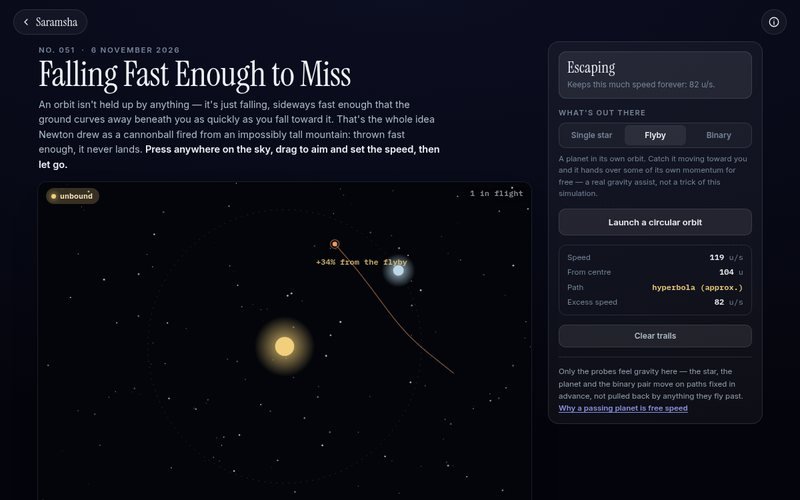
Falling Fast Enough to Miss
An orbit is just falling, sideways, fast enough to keep missing the ground. Drag to launch a probe past a star, a moving planet or a binary pair, and read off its real orbital mechanics.
Open
Fifty Minutes Later
The Moon rises about fifty minutes later each day than the day before, a drift that skips a calendar day once a month. Plan a month of moonrises for any place on Earth.
Open
The Trailing Edge Decides
A wing doesn't lift because split air reunites behind it — that's a myth. A sharp trailing edge forces smooth flow off the back, and that one condition fixes the circulation, the lift, and where a real wing stalls.
Open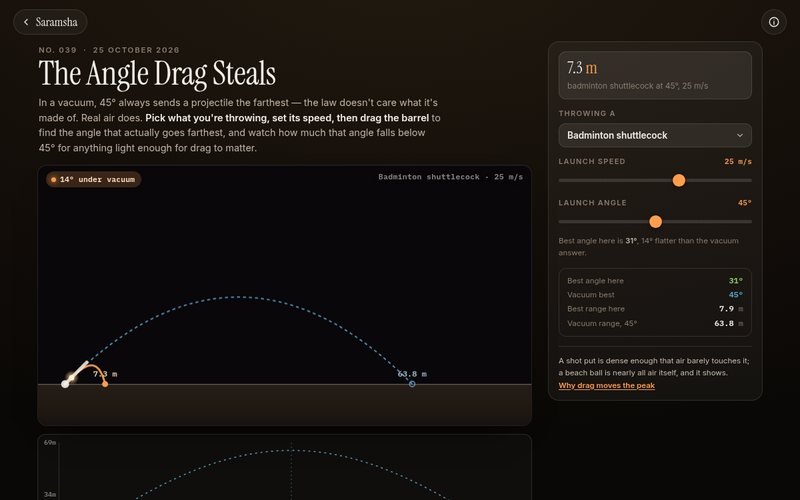
The Angle Drag Steals
In a vacuum, 45° always sends a projectile the farthest. Launch a shot put, a baseball, a shuttlecock or a beach ball and watch air resistance pull that angle down.
Open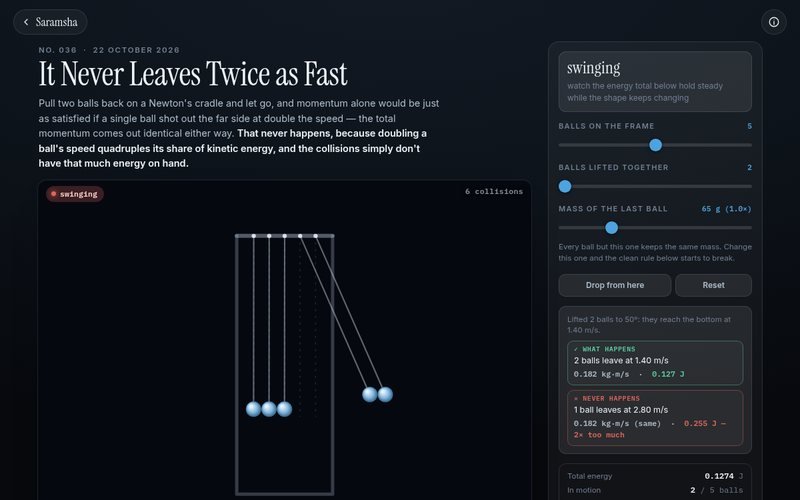
It Never Leaves Twice as Fast
Lift two balls on a Newton's cradle and momentum alone would be happy to send one ball out at double speed. Watch why that never happens, collision by collision.
Open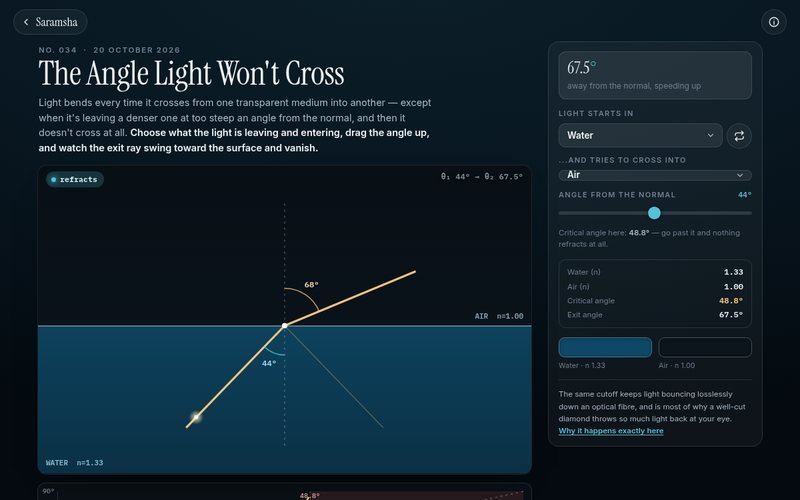
The Angle Light Won't Cross
Light bends crossing into any other transparent medium, by Snell's law — except leaving a denser one steeply enough, where it can't cross at all. Find that exact angle in water, glass and diamond.
Open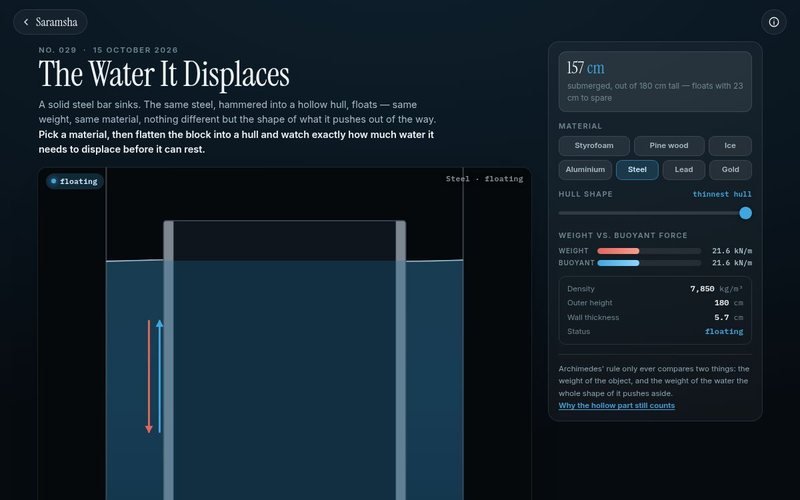
The Water It Displaces
A solid steel bar sinks; the same steel, hammered into a hollow hull, floats. Flatten a block into a hull and watch exactly how much water it has to push aside before it can rest.
Open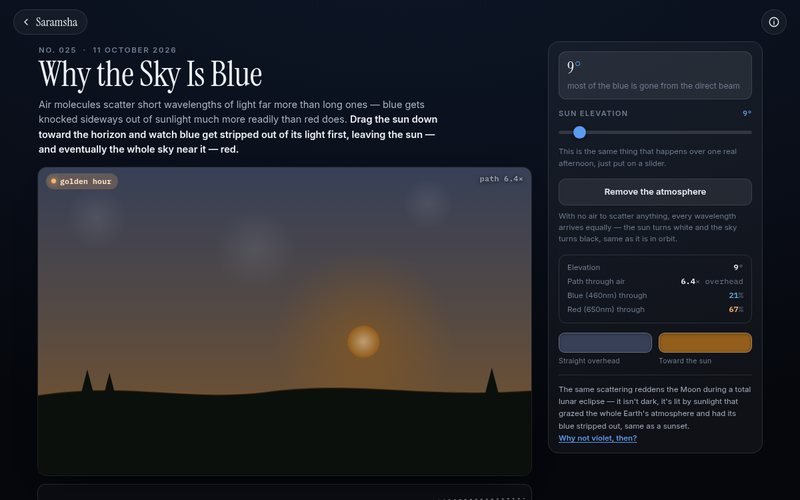
Why the Sky Is Blue
Air scatters short wavelengths of light far more than long ones. Drag the sun down toward the horizon and watch blue get stripped out of its light first, leaving the sun red.
Open
Push With It, Not Against It
A swing pumped exactly on its own beat swings far higher than one pumped harder but off time. Drag the push-rate slider and trace out the resonance curve yourself.
Open
As Far As You Like
Stack flat blocks past the edge of a table, one at a time, and find out how far the top one can reach before the tower falls. The exact record for n blocks is half the harmonic series — a sum that never stops growing, just agonisingly slowly.
Open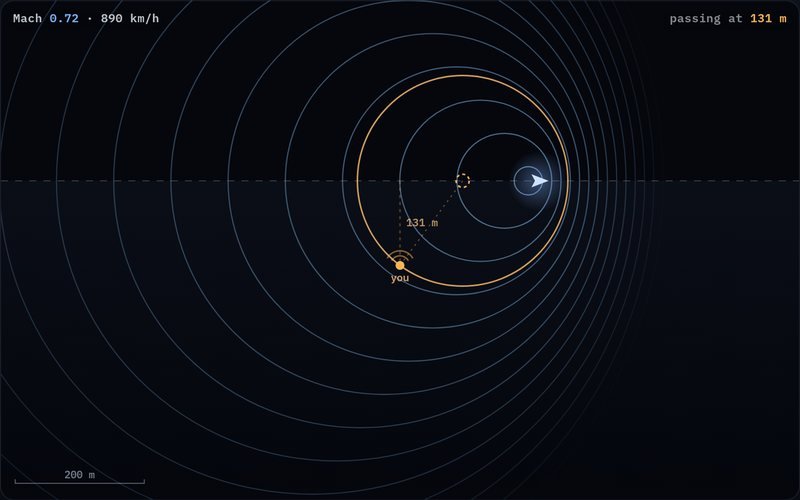
Why the Siren Drops
A siren holds one note the whole way past; what changes is the spacing of the crests it leaves in the air, crowded ahead and stretched behind. Send it by at anything from bicycle pace to Mach 1.3, and hear why the true pitch reaches you only after it has gone.
Open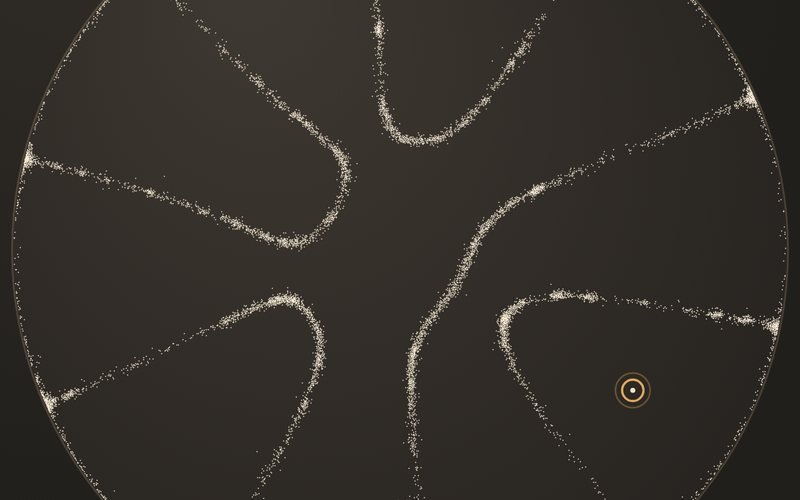
Sand Finds the Silence
Sand on a bowed metal plate is thrown off everything that is moving and comes to rest on the lines that are not, so it draws the shape of the note. Hunt for one of the plate's own pitches, move the bow to choose between figures that share it, and watch thirteen thousand grains walk into place.
Open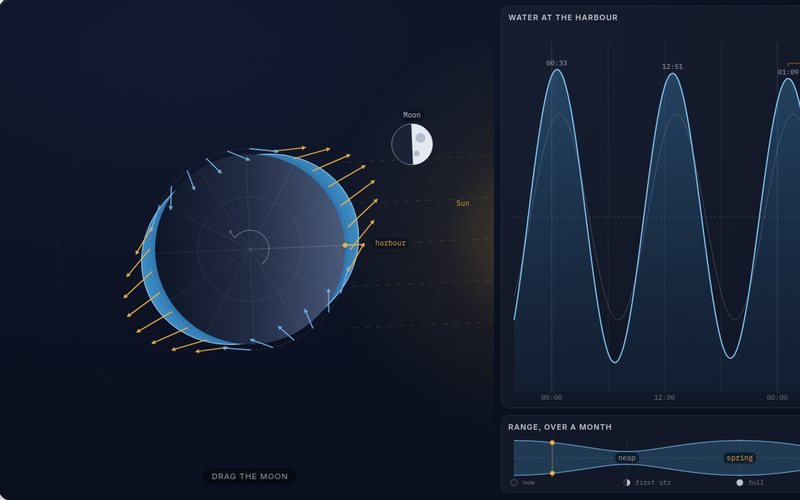
Pulled Both Ways
The Moon raises a bulge of ocean on the side facing it and an equal one on the far side, which is why a harbour gets two high tides a day. Drag the Moon round its orbit, subtract the pull the whole Earth feels, and watch what is left over push the water out at both ends.
Open