All apps / Series
Word and Script
Language treated as a structure you can measure — metre, meaning, and the shape of a text.
Text looks unstructured until you measure it, and then it turns out to be full of rules: which sentences carry the meaning of a document, which syllables are heavy, where a line of verse must break. Some of those rules were written down two thousand years ago and still hold. These pages take a piece of language and show you its skeleton.
In this series

The Long Way to English
Sugar came through Sanskrit, Persian, Arabic and Italian before it reached English. Pick a word and follow the route it actually took, then check seven word-origin stories that are flat-out false.
Open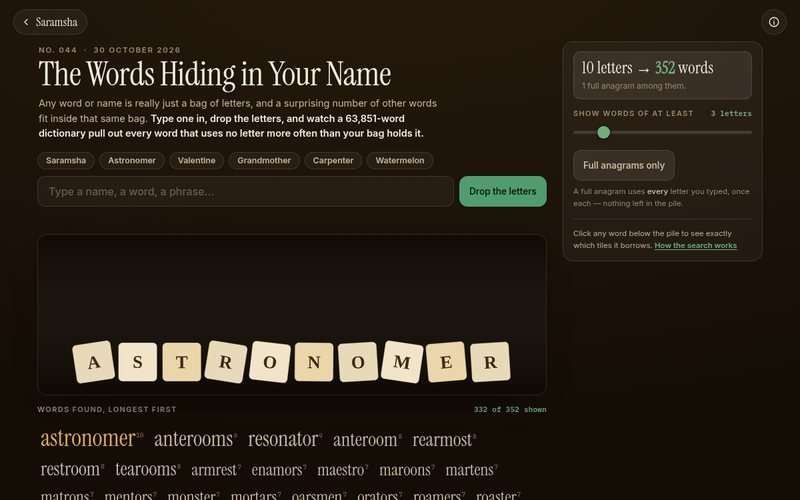
The Words Hiding in Your Name
Type a name or word and watch every English word that fits inside its letters — each one used no more than it appears — climb out of the pile.
Open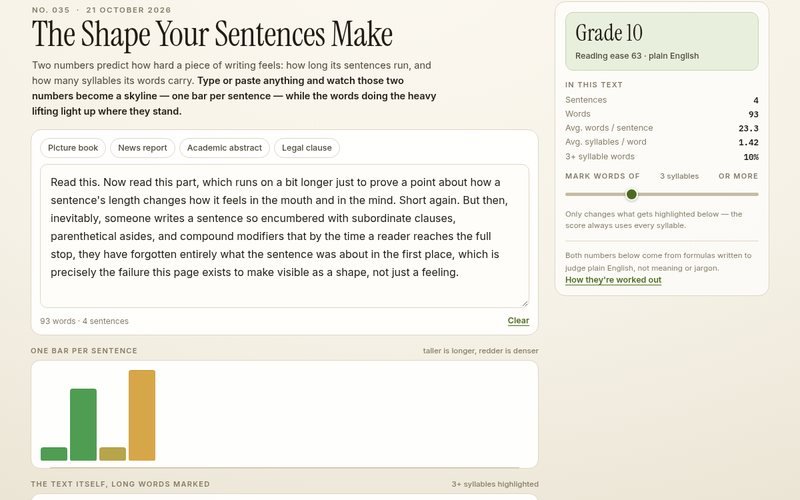
The Shape Your Sentences Make
Two numbers predict how hard a piece of writing feels: how long its sentences run, and how many syllables its words carry. Watch them become a skyline.
Open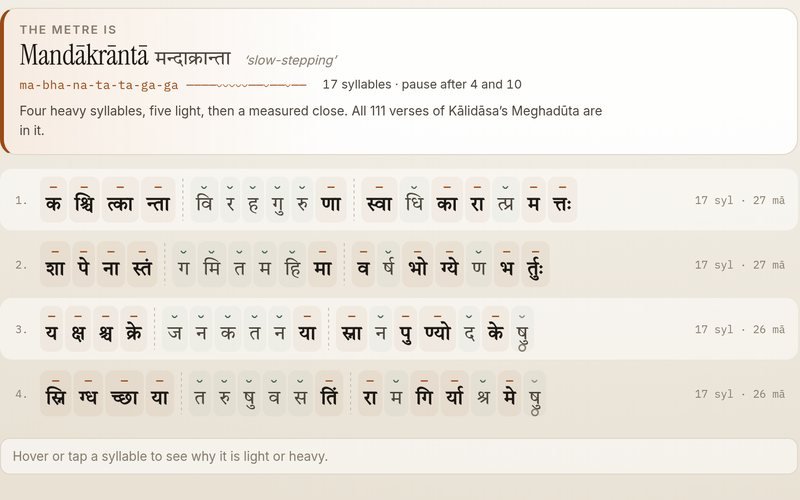
The Weight of Syllables
Sanskrit verse is measured by weight, not by stress or rhyme: every syllable is light or heavy, and a metre is one fixed sequence of the two. Paste a verse in Devanagari or roman to see it scanned syllable by syllable, the mātrās counted, and the metre named out of twenty-three.
Open
Saramsha
Paste any text and see which sentences carry its meaning. A TextRank summarizer that runs entirely in your browser.
Open